
Literacy centers, stations, or just “centers”—different names, same idea. They have so many benefits for students and teachers, even in upper elementary and middle school. Think easy differentiation, built-in practice with stamina, independent work skills, collaboration, and time for small-group direct instruction. But literacy centers come with real challenges too. Here are 5 of the most common obstacles teachers run into with literacy centers, along with tips for tackling each one.
Literacy Centers Challenges (and Practical Fixes)
1. Student Engagement in Literacy Centers
If students aren’t engaged, it leads to a whole cascade of other issues. Engagement problems usually come down to two things: underwhelming activities and unclear procedures.
Keep the center tasks interesting, and take the time to gather materials with that in mind. The older and more mature your students are, the more choice you can build in. Offer menu options or a “Must Do, May Do” list for students who can handle more freedom. Later in the year, you might even have students propose their own center schedule for the week and run it by you—then hold them accountable for meeting the goals they set.
The bottom line is that keeping students engaged reduces other issues that can arise in classroom learning centers.
2. The Crucial Time-Management Factor
Your centers will look different from another teacher’s simply because your schedule is different. What do your class periods actually look like? That’s the starting point for setting up literacy centers.
You’ll need to factor in transition time if students are rotating, plus time for a short lesson and a wrap-up. Don’t forget the interruptions that happen during a normal week—fire drills, rallies, announcements, and more. Know what to expect (and expect the unexpected), and build your plan around what you actually have to work with.
You’ll also need a simple way for students to know where to go next. Color-coding is the easiest system: instead of writing names over and over, just tell students which color they are for the week. Write the stations on the board, then use colored index cards that are moved to the next center each time a rotation happens. Make sure to work on transition times early in the year so it sets the stage for efficiency.
3. Behavior Management and Literacy Centers
Give yourself time to get to know your students before you launch centers. The makeup of your class will change from year to year, and that shapes how you run things.
A critical piece of behavior management is practicing the routines you expect to see—modeling them, and modeling them again. Practice noise levels. Put up a poster in your classroom, refer to it throughout the day, and connect it to what will happen during centers. You might even post a sign at each center with the noise-level expectation. When you are running centers and it gets too loud, stop everything immediately and reset those standards. Point to the poster and remind all students of the expectations.
The more you practice routines, the better student behavior will be. It also helps to train students on what to do when they don’t understand something in a center. I love the poster I created for this (you’ll find it in this literacy centers unit)—it walks students through a short series of prompts to try before they ask for help. Teaching that procedure cuts down on behavior issues, builds independence, and allows teachers to focus on their own goal..
A few questions worth thinking through when establishing routines:
- How will students get their materials?
- What will the work setting look like—partner work, independent work, group work? Will there be headphones, Chromebooks, etc.?
- Where will students turn in their work?
- What happens to work that isn’t completed?
- What will early finishers do once their center work is done?
- Is there a different option for students who are ready for more independence—can they propose their own schedule?
- Do you want to give a key for some centers so students can score their own work? If so, what would this look like?
If your students are older, adding more choice can also help with behavior as well.
4. Organizing Differentiated Materials
Prep your centers for differentiated levels of work, whatever that looks like for your class—different reading levels of the same passage, or passages on the same topic (like identifying character traits or conflict). It’s worth the time to track down materials that actually work for your students.
Keep your center materials organized in folders, and note what you’ve already used. Building an easy system now makes next year that much simpler, especially if it includes options for every student in your room.
Differentiation options to consider:
- Reduced reading
- Less text per page/larger text size
- Audio versions
- Wider spaces for writing
- Reduced answer options
- Leveled passages
- Fewer tasks
- A reference page for scaffolding
- Allowing certain students to stand or move if it helps them focus
- And more
5. Tracking Individual Progress in Literacy Centers
Depending on your school’s schedule, you might see up to 150 kids a day. That’s a lot—and grading that much work is a real burden. Building a streamlined system for tracking what each student has mastered is essential for your sanity.
One of my favorite methods is a quick reflection sheet built right into each center task. See reflection sheets here. Another is a clipboard with your mastery goals listed above a class roster—whether you’re checking work individually, checking in verbally, or just observing over a student’s shoulder, having that page handy lets you jot quick notes on progress.
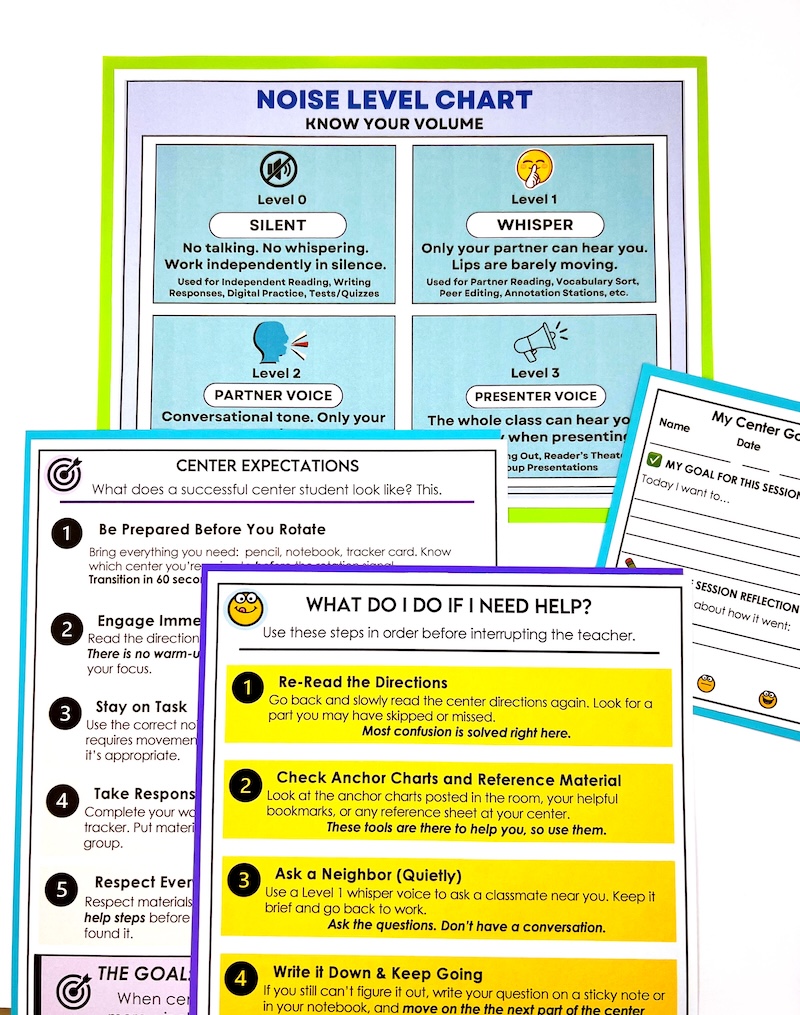
You could also use a short Google Form to track progress, or have exit tickets ready with a quick question tied to each center’s focus. Since students probably won’t make it to every center in a day or two, prepare a question for whichever center they worked on that day. Project it, hand out tickets as students rotate, or pass them out as a wrap-up activity.
I cover more quick-reflection options like these in this Literacy Centers Unit.
Literacy centers will never run perfectly. There will always be a noisy transition, a student who finishes early, or a stack of exit tickets you didn’t quite get to. But every one of these challenges gets easier with a little planning and a lot of repetition. Start with just one or two tips from this list, give your routines time to stick, and build from there. If you’d rather skip the trial and error, my Literacy Centers Unit has the anchor charts, rotation schedules, goal-setting cards, early finisher activities, and discussion prompts already built out for you—so you can spend less time planning centers and more time watching your students grow.
Save this for later on your favorite Pinterest board.
I’m teaming up with some of my favorite bloggers. Learn even more classroom hacks to make teaching easier.


Leave a Reply